
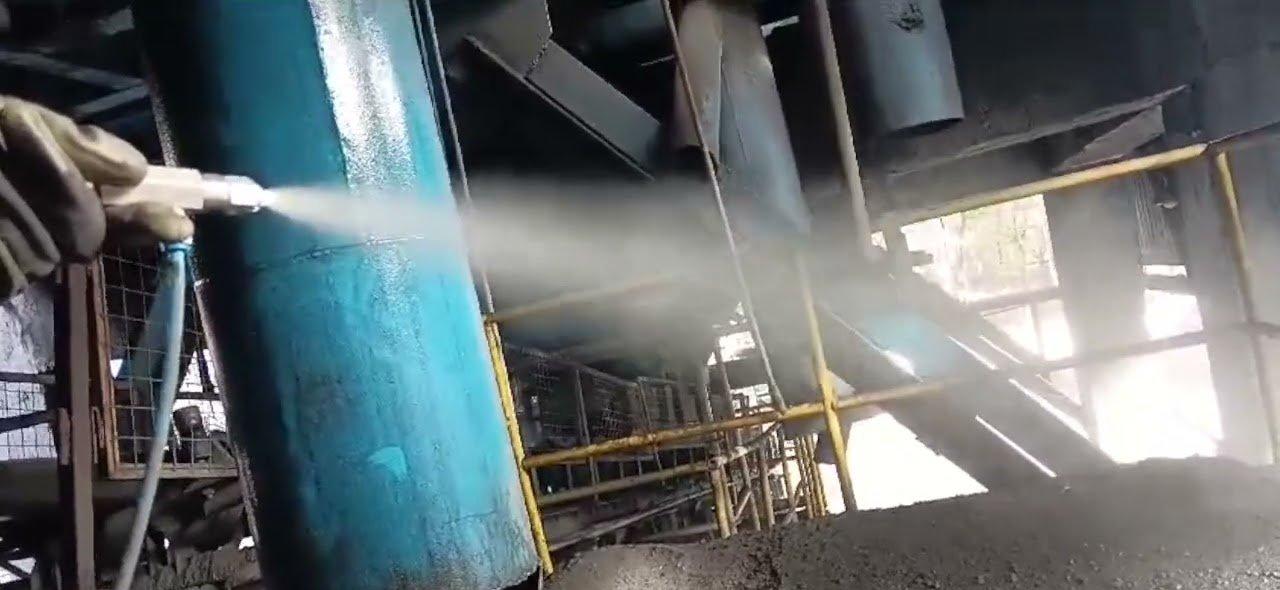
A dry fog dust suppression system (DFDS) uses compressed air and plain water to produce droplets of 10 microns or less. These droplets capture even the smallest airborne dust particles, then settle without wetting the material.
Because it adds very little moisture, DFDS suits plants where extra water causes problems.
Redshift DFDS systems are installed in multiple plants across India, and our DFDS nozzles are known in the industry for their efficiency.
How droplets capture dust
Dust is captured best when the water droplets are about the same size as the dust particles. Fog droplets of 1 to 10 microns match respirable PM10 and PM2.5 dust, so the two collide, bind together and fall back onto the material stream instead of staying airborne.
Larger spray droplets behave differently: fine dust is carried around them in the air stream, which is why plain sprays struggle with the finest particles.
Two nozzle technologies
- Dual-fluid (air-atomising) nozzles — low-pressure compressed air (about 5 bar) and water (about 1 bar) produce droplets of 1 to 10 microns. Best for enclosed transfer points, crushers and moisture-sensitive materials.
- High-pressure hydraulic nozzles — water alone at about 80 to 100+ bar through fine orifices produces a 30 to 60 micron mist, for semi-enclosed hoppers and outdoor receiving areas.
System components
- Nozzle headers or nozzle frames mounted at each dust source, inside the chute or skirt board
- Water and air filtration cabinet, filtering down to 5 microns, to keep nozzles clear
- Pressure regulation for the water and air supplies, so droplet size stays consistent
- PLC control that switches each zone on only when material is flowing, using belt-motion or level sensors
Where it is used
- Conveyor transfer points and chutes
- Crusher inlets, screens and discharge zones
- Wagon tipplers, truck dumpers and hoppers
- Coal handling plants, cement mills, steel plants and port loading
Performance
Moisture added to the material can be kept to about 0.1% by weight or less. Dry fog can cut respirable PM10 and PM2.5 dust by up to 99%, and uses up to 90% less water than conventional spraying. Actual results depend on the material, the enclosure and site conditions, so we size each system for its site.