
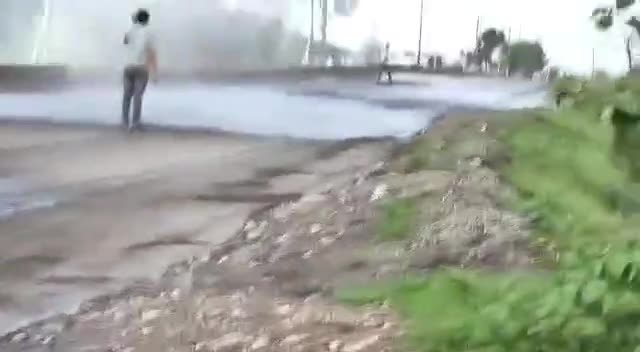
Trucks on plant roads and haul roads lift a constant cloud of dust. A roadline system lines the road with rain guns that lay a measured curtain of water on the surface, binding the dust before it becomes airborne, without manual tanker runs.
System layout
- Water source with two-stage filtration: a sand media filter followed by a flanged twin-disc filter
- High-head multi-stage centrifugal pump skid
- Heavy-class (Class B) GI mainline and sub-mainline
- GI header manifold with pressure gauges, non-return valves and a safety bypass
- Zone control valves and rain guns along the road
Zoned, automatic operation
The road is split into zones that run one after another. This keeps the pump and pipe sizes economical while every stretch of road still gets wet on schedule. A PLC opens each zone valve in turn, with a manual override for the operator.
Rain gun configuration
- Throw of up to 30 m per rain gun, enough to wet the full road width
- Adjustable trajectory from 24° to 45° to limit drift in high wind
- Full- or part-circle setting, so only the road is sprayed and nearby structures stay dry
- Heavy droplets that settle dust without turning the road to mud
Results
A well-designed roadline system can reduce airborne road dust by up to 90% and use up to 60% less water than unmonitored tanker spraying, with no manual labour during operation. Actual results depend on traffic, road surface and weather.
Scope and support
We handle engineering design, supply of the pump skid, filtration, control panel and piping network, and complete erection and commissioning. Each system comes with a one-year service warranty, and an AMC is available after that.