
We provide a wide range of dust suppression systems, and we help you choose the right one for your unit. Call us for a free consultation.
Why dust needs controlling
Dust is generated whenever bulk solid material is moved or altered. Where a dust cloud is visible, there is also respirable dust you cannot see. Airborne particles of silica, limestone, cement, coal and aggregate, from 0.1 to roughly 70 microns, are a health hazard, waste material and wear out pulleys, idlers, belting and motors.
Conveyor transfer points are a prime source of fugitive dust and spillage. The material, drop height, belt speeds and loading angles all decide what kind of system is needed there.
How dust suppression works
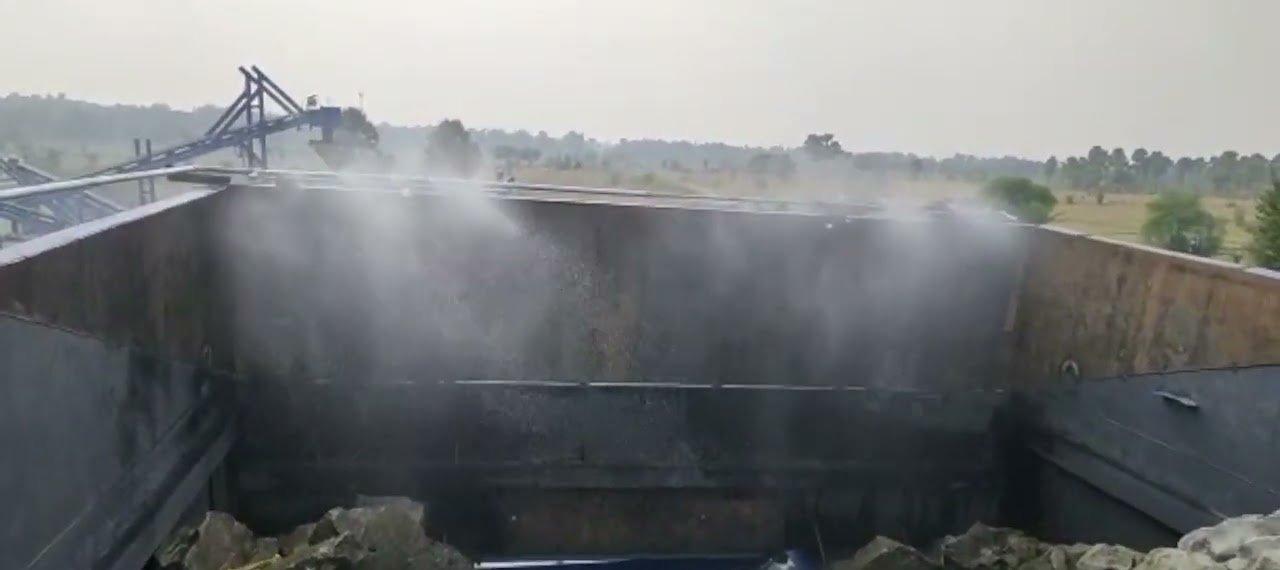
Dust suppression applies water, with or without additives, either to the material itself so fines stay in the bed, or to the air above it so airborne fines return to the bed. Because the suppressed dust rejoins the main flow, the material does not have to be handled again.
Plain water suppression
Wetting the fines makes each particle heavier and binds the material together, so it is less likely to become airborne. Water is applied through correctly sized spray nozzles where the material expands and draws in air.
Water is cheap, but too much of it causes problems: build-up on chutes, screens and belts, blinded screens, belt slippage and sticky fines. For coal and coke used as boiler fuel, excess moisture also lowers heat rates.
Dry fog (DFDS)
Where moisture must be kept to a minimum, a dry fog system uses compressed air and plain water to produce droplets of 10 microns or less. They capture even the finest dust and settle without wetting the material.
Nozzle placement is critical. The fog is generated above the dust source, inside properly designed shrouding that shields it from wind and gives it time to work.
Other systems we supply
- Sprinklers — wide-area wetting for roads and open yards, set to full or part circles. Typical water use 0.3 to 95 m³/hr.
- Rain guns — fast, even wetting over large areas. 12 to 150 m³/hr, with throws up to 120 metres.
- Water spray nozzle systems — cone sprays at 1 to 8 bar for material handling and site boundaries. Plastic, stainless steel or brass, 0.3 to 90 litres/min per nozzle.
- Fog cannons — a fan-assisted barrel with up to 60 nozzles that throws fine droplets many metres, for large open areas where a fixed system is not practical.
Redshift sprinklers, rain guns, nozzles and fog cannons are available from stock. Call us to enquire.